The Shift to Agentic AI in 2026 | Autonomous Marketing Ops Is Here

Most marketers are still in AI-assisted mode.
Generate a few angles. Draft a few ads. Summarize a report. Ship faster.
That era is ending.
Marketing is crossing the chasm into Agentic AI: systems of specialized agents that plan, execute, evaluate, and optimize work continuously. Not just content. Not just analysis. Actual operations.
The old model was campaign-based. Launch. Monitor. Iterate. Repeat.
The new model is always-on optimization.

What agentic AI marketing actually means
Agentic AI is not one model doing everything. It is a set of role-based agents that hand work off like a real team:
Analyst agent pulls performance signals and flags anomalies
Strategy agent proposes hypotheses and prioritizes tests
Creative agent generates variants tied to a specific angle and constraint
Media buyer agent adjusts budgets, bidding, and audiences inside guardrails
QA agent checks claims, brand rules, and compliance
Ops agent updates the CRM routing and lifecycle automation
That is not theory. It is the direction the tooling ecosystem is pushing hard right now.
Why this is happening now
Three forces are converging.
AI usage is no longer occasional
A large share of marketers report using generative AI daily for real workflows, not side tasks. The numbers vary by survey, but the direction is consistent. The research brief referenced 88% daily usage via Averi.ai. What matters is the implication - AI is now workflow infrastructure.
Search is turning into answers, not visits
Zero-click search was already a thing. Now it is becoming zero-visit discovery where an answer engine summarizes the web, then the user keeps interacting inside the AI layer.
The result: impressions stay up, while clicks get weird.
Agents are moving from assist to act
The brief cited 79% adoption of AI agents reported by the Digital Marketing Institute. Treat the exact number as survey-dependent, but the headline trend is real: teams are experimenting with agents because agents reduce cycle time.
The real so what for growth
If you sell growth consulting or you run growth in house, you need to internalize two ideas.
Idea 1: The campaign model is dying
Campaigns assume a start and an end. Agentic ops assumes a loop:
detect bottleneck
generate tests
ship variants
measure lift
learn
repeat
Always on. Weekly if you are early. Daily if you are serious.
Idea 2: Being readable by AI is the new SEO
This is the Brand Twin strategy.
In a world where consumer-side agents filter options, you win by being the easiest brand to understand at machine speed.
That means structured data. Clear product facts. Clean policies. Transparent pricing logic. Real FAQs. Stable pages that do not contradict each other.
In other words, your website becomes an API even if you never ship an API.

The next layer is agent-to-agent commerce
This is the part most people are not ready for.
Consumer agents will negotiate directly with brand agents for pricing, promotions, and bundles. Fewer humans browsing pages. More agents comparing offers. More negotiation happening programmatically.
Even if this is early stage, the direction is obvious.
So your growth edge shifts from ad cleverness to offer logic and data clarity.
The big risk - the generic trap
creative converges
brand voice collapses
Your only real advantage becomes first-party data plus taste.
first-party data: what your customers asked, objected to, bought, and churned on
taste: your standards, your constraints, your willingness to be specific
If your agents are trained on your actual sales calls, your real objections, and your real wins, you will not sound like everyone else.
If they are trained on internet averages, you will.
Implementation reality in 2026 - medium maturity, high friction
Here is the honest assessment.
What is mature enough to ship:
multi-agent workflows for analysis, creative, QA, and reporting
supervised budget pacing with guardrails
automated experimentation pipelines for ads, landing pages, and email
deeper integrations with modern CRM and analytics stacks
What is still hard:
governance inside legacy stacks
permissioning and audit logs
data cleanliness across CRM, analytics, and attribution
preventing agents from doing dumb expensive things at scale
This is why full autonomy is still rare. Most winners will run semi-autonomous loops with human approval on critical actions.
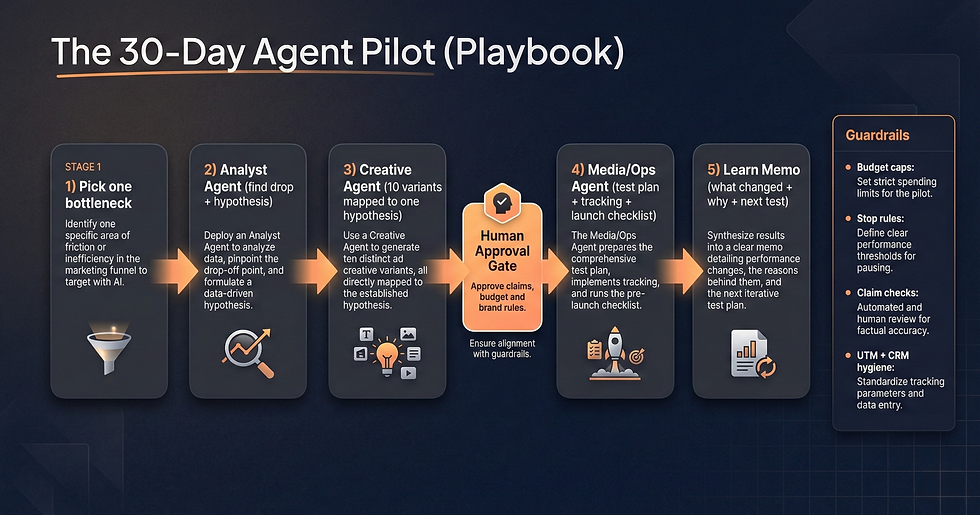
The playbook - how to pilot agentic marketing without chaos
Step 1: Run an AEO audit
Your content should be structured for answer engines, not just keywords.
Do this on your top revenue pages:
add a one-sentence definition near the top
add a short step list
add an FAQ section with direct answers
replace vague claims with proof or constraints
make one canonical page per topic, then link everything to it
Step 2: Pilot a 3-agent loop on a small budget
Do not start with six agents. Start with three.
Analyst agent
pulls the last 14 days
finds the biggest drop
proposes five hypotheses
Creative agent
generates ten variants tied to one hypothesis
labels each variant with the angle
outputs copy plus creative direction
Media agent
sets up a test plan
allocates a fixed test budget
schedules checks and stop rules
Human approves:
the hypothesis
the final variants
the budget
Run this loop weekly for four weeks.
Step 3: Build a truth doc so agents do not hallucinate your brand.
One living doc with:
ICP definition
top pains in customer language
top objections
proof points you can defend
tone rules
compliance rules
banned phrases
Agents get smarter when you stop asking them to guess.
Step 4: Decide what you gate
If your content is genuinely proprietary, consider gating parts of it.
Not because you are paranoid. Because your best content becomes training data for everyone else.
Gate the pieces that are uniquely yours:
templates
playbooks
benchmarks
teardown frameworks
internal process docs
Keep the clarity pages open so you can still be discovered.
What this changes by business type
For B2B
SDR work is being unbundled.
Agents can research leads, personalize outreach, and book meetings. Humans shift to discovery quality, deal strategy, negotiation, and closing.
For B2C
Hyper-personalization becomes operational, not optional.
Agentic systems will assemble the page, the offer, the message, and the proof based on visitor context in real time.
Your job becomes building the components and the guardrails.
My final thoughts
Agentic AI is not a cool feature. It is a new operating model.
If you are a growth marketer, the win is not use more AI. The win is:
build an always-on test loop
make your brand machine-readable
train agents on first-party truth
keep a human in the loop where risk is real
If you want a simple starting point today - pick one funnel bottleneck, then build a three-agent loop around it for 30 days. You will learn more from that than from another month of tool browsing.

Comments